Patient story
Veneers
Veneers in Vietnam for New Zealand patients
Porcelain and composite veneers at Picasso Dental Clinic from NZD 200 per tooth, with the Portrait Sitting protocol, 7-year ceramic warranty, and written NZD plans.
New Zealand patients can receive Emax Press porcelain veneers at Picasso Dental Clinic in Vietnam from NZD 600 per tooth — compared with the NZD 1,500 to NZD 2,500 per tooth typical of New Zealand private practice — with the Portrait Sitting protocol covering photography, shade planning, conservative 0.3 to 0.5mm preparation, temporaries, final ceramic bonding, and a written 7-year warranty (May 2026, 1 NZD = 15,000 VND).
Veneers are the most common reason New Zealand patients fly to Picasso Dental Clinic. The price gap is wide, the visual change is high, and most cases finish in a single trip.
They are also irreversible once enamel is prepared. That is why the decision should never start with the whitest shade or the cheapest package. The better question is whether your smile can be improved while keeping as much healthy tooth as possible — using a material and timeline that still make sense after flights, accommodation, leave, and aftercare.
Picasso built the Portrait Sitting protocol around that question.
What a veneer actually is
A veneer is a thin restoration bonded to the front surface of a tooth. It can improve colour, shape, minor spacing, edge wear, small chips, tooth proportions, and smile symmetry.
A veneer is not a crown. A crown covers the entire tooth and usually requires 1.5 to 2mm of reduction on every surface. Crowns are appropriate when a tooth is heavily broken, root-canal treated, cracked, or structurally weak. Veneers are appropriate when the front surface needs cosmetic change and the underlying tooth is otherwise sound.
That distinction matters because most overseas horror stories — the so-called Turkey teeth cases — come from patients who thought they were getting veneers but received aggressive crown-style preparation. Read Turkey teeth explained before booking any cosmetic work overseas.
Picasso veneer prices in NZD, May 2026
Prices below are from the May 2026 Picasso price list, converted at 1 NZD = 15,000 VND. Each price is per tooth and includes the ceramic, bonding, and the final visit.
| Veneer type | Picasso price per tooth | Warranty | Best for |
|---|---|---|---|
| Composite veneer | NZD 200 | 6 months | Small chips, trial aesthetics, conservative cases |
| Emax Press porcelain | NZD 600 | 7 years | Most full smile makeovers, the default ceramic |
| Emax Press Plus porcelain | NZD 667 | 7 years | Cases needing higher translucency or colour control |
| Non-prep Emax | NZD 733 | 7 years | Small or narrow teeth where enamel can be preserved |
| Lisi porcelain | NZD 800 | 7 years | Premium aesthetics where shade detail is critical |
A 10-tooth Emax Press case is NZD 6,000 before flights and accommodation. A 16-tooth case is NZD 9,600. A 20-tooth case is NZD 12,000.
All five materials are quoted on the same written treatment plan so you can see exactly which teeth use which ceramic and why. See the full itemised pricing list for every treatment line.
For the full New Zealand-vs-Vietnam breakdown with city-by-city benchmarks, see our veneers cost guide.
New Zealand vs Vietnam — the honest economics
| Case | Typical NZ private range | Picasso Vietnam | Indicative saving |
|---|---|---|---|
| 1 porcelain veneer | NZD 1,500 to NZD 2,500+ | From NZD 600 | NZD 900 to NZD 1,900 |
| 10 porcelain veneers | NZD 15,000 to NZD 25,000+ | From NZD 6,000 | NZD 9,000 to NZD 19,000 |
| 16 porcelain veneers | NZD 24,000 to NZD 40,000+ | From NZD 9,600 | NZD 14,400 to NZD 30,400 |
| 20 porcelain veneers | NZD 30,000 to NZD 50,000+ | From NZD 12,000 | NZD 18,000 to NZD 38,000 |
The New Zealand ranges are planning benchmarks based on indicative private fees, not a promise about any specific Auckland, Wellington, Christchurch, or Hamilton clinic. Always ask your local dentist for an itemised written quote so you compare like with like.
The break-even logic is simple. For one veneer, stay in New Zealand unless you are already travelling. For 10 or more veneers, the saving comfortably covers return flights from Auckland (around NZD 1,200 to NZD 1,800) and a week of accommodation in Da Nang or Hanoi (NZD 700 to NZD 1,400), with thousands left in your pocket.
Read veneer costs — New Zealand vs Vietnam for the detailed cost model, or jump straight to a free NZD quote.
Real Picasso veneer cases — before and after
These are three real patient cases treated with porcelain veneers at Picasso Dental Clinic. The most dramatic case below started with chipped, broken upper front teeth; the result is full Emax Press porcelain veneers placed using the Portrait Sitting protocol. Cases are shown with patient consent for clinical documentation.
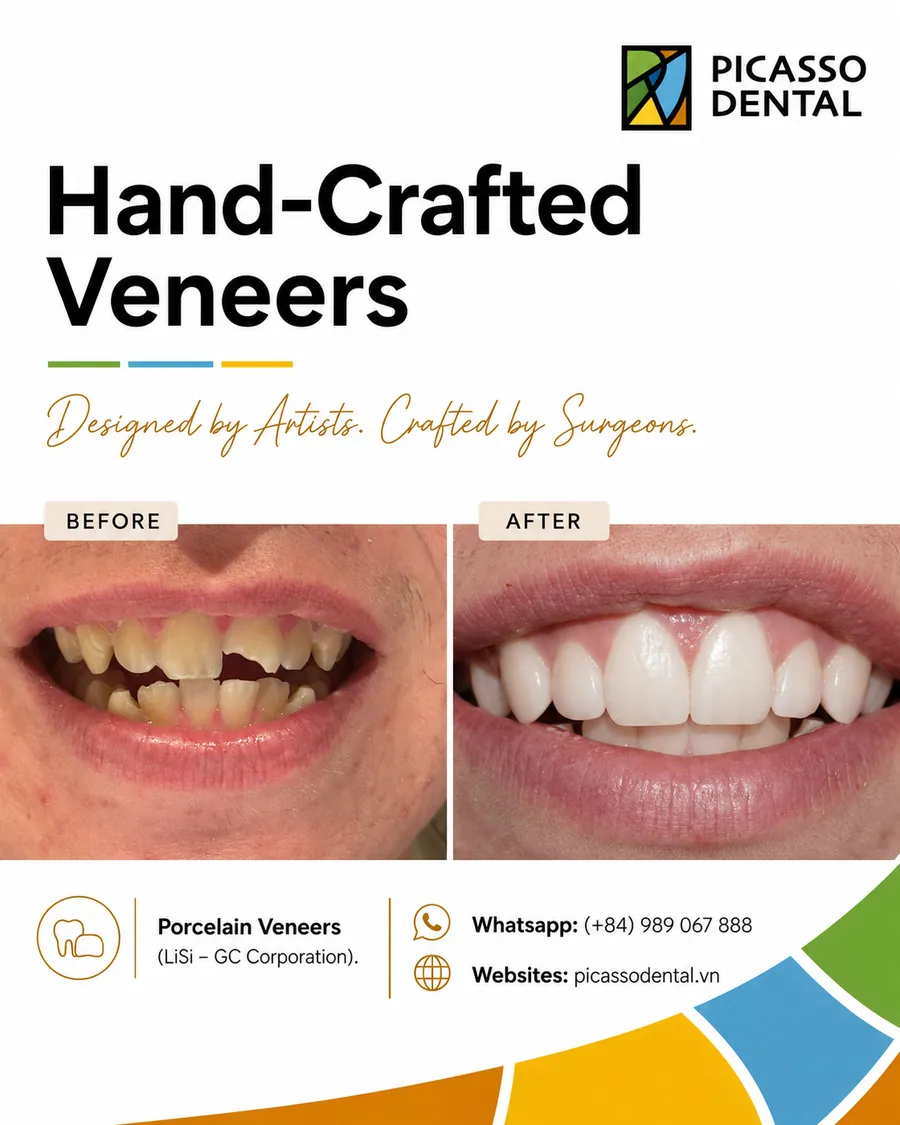
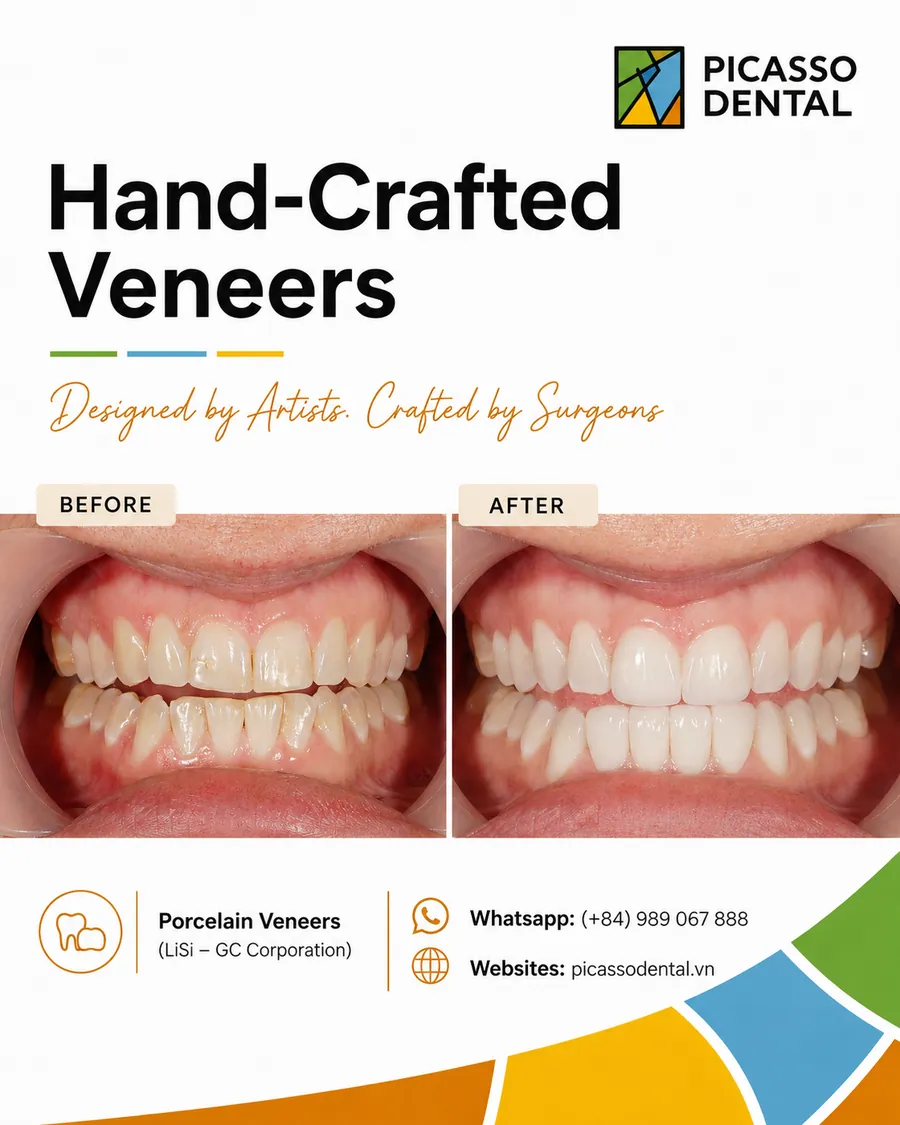
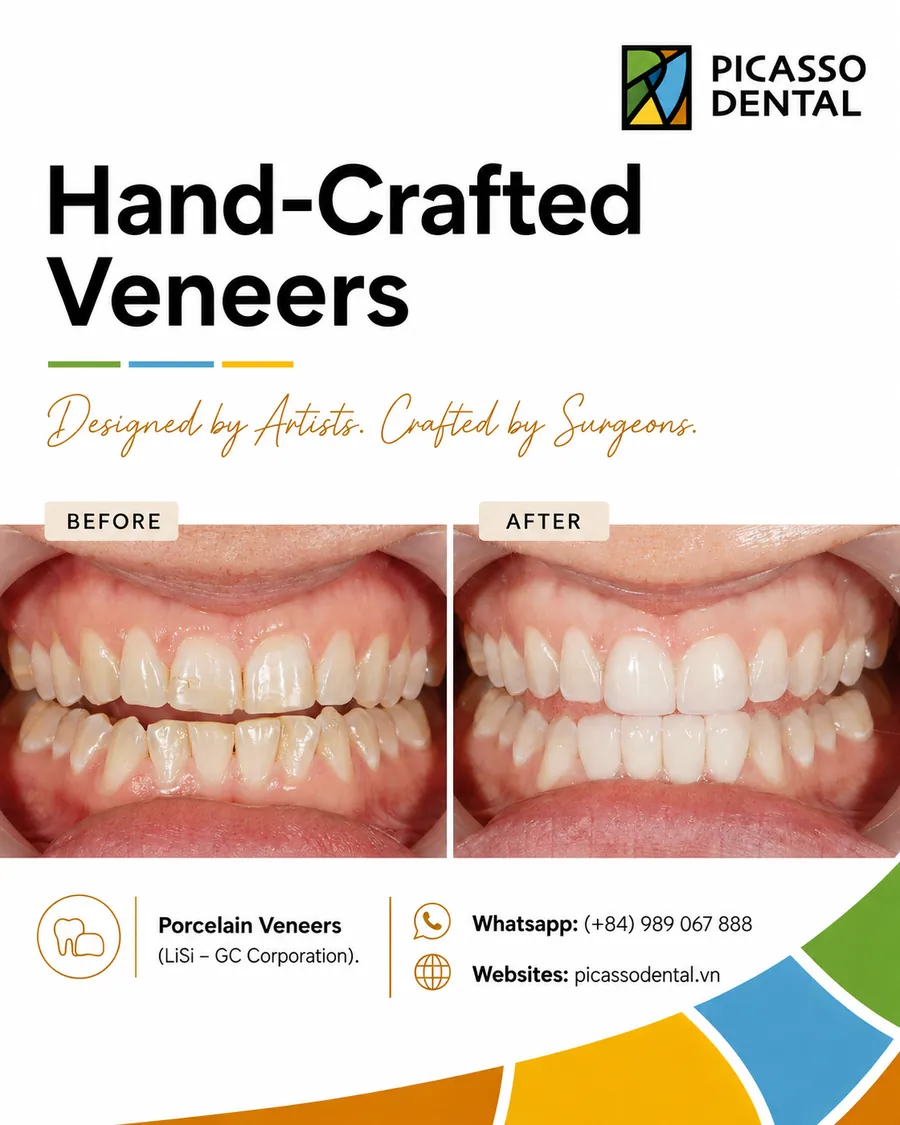
Real Picasso patient cases. Suitability, preparation depth, and final result vary by patient — confirmed in writing only after in-person examination, photographs, and X-rays. Patient consent on file. Read Turkey teeth explained for the difference between veneers and over-prepared crowns.
These three cases together show what the Portrait Sitting protocol is designed for: severe restorative work, moderate cosmetic improvement, and conservative refinement — using the same materials, the same planning workflow, and the same 7-year written ceramic warranty. None of them are stock photography. All were treated and photographed at Picasso clinics.
Veneer patients on camera
Photographs show the result. Video shows the process, the timeline, and whether the patient sounds like someone who was rushed. Both of the patients below had veneer treatment at our Hanoi clinic — one an eight-unit case, the other a five-day journey filmed end to end.
Patient story
He Asked ChatGPT Where to Fix His Smile. It Sent Him to Us. | 5-Day Veneer Journey at Picasso Dental
Patient story
She Flew 10,000km for a New Smile and Ended Up Looking 10 Years Younger!
Disclosure. We filmed and published these videos on our own YouTube channel, so they are clinic marketing rather than independent reviews. The patients shown travelled from Australia, France, and elsewhere — none are New Zealand residents. For reviews we do not control, see our branch Google profiles.
Portrait Sitting — the five-step protocol
Portrait Sitting is Picasso’s response to the high-volume “smile in a week” model that has caused so many overseas problems. It treats a smile as something that sits inside a face, not a row of identical white blocks.
1. Photography and facial analysis
Before any preparation, the team studies tooth proportions, smile arc, lip line, midline, gum line, edge display, and face shape. This avoids smiles that look technically neat on the model but visually wrong on the person.
2. Shade and shape discussion
Some patients want bright cosmetic results. Others want a natural upgrade that does not announce itself. Picasso agrees the shade and shape in writing before the lab makes the final ceramics — so the result is intentional, not guessed.
3. Conservative preparation
Emax Press veneers at Picasso are placed with 0.3 to 0.5mm tooth reduction where preparation is required. Non-prep Emax cases remove less. That does not mean every tooth can be no-prep — your enamel thickness, tooth position, and aesthetic goals decide. The principle is to remove the least healthy tooth structure needed for strength, fit, and appearance.
4. Temporaries
You wear temporary veneers between the preparation visit and the final bonding visit. This is the most important checkpoint. You eat, speak, and live with the shape and length for several days. If something needs to change — slightly shorter, slightly less prominent, a softer edge — the lab adjusts the final ceramics before they are made.
5. Final bonding and bite check
The final visit is not only about appearance. The dentist checks bite contacts, margins, comfort, and aftercare instructions before you fly home. You leave with a written treatment summary, shade record, material details, and warranty documents for your New Zealand dentist.
Porcelain vs composite veneers
| Factor | Porcelain (Emax / Lisi) | Composite |
|---|---|---|
| Picasso price | NZD 600 to NZD 800 per tooth | NZD 200 per tooth |
| Typical lifespan | 10 to 15 years with good care | 3 to 7 years |
| Stain resistance | High — does not absorb coffee, wine, smoke | Lower — stains over time |
| Repair | Usually requires lab replacement | Can often be polished or patched chairside |
| Preparation | 0.3 to 0.5mm or non-prep where suitable | Often minimal |
| Warranty | 7 years | 6 months |
| Best fit | Full smile makeovers, lasting aesthetic cases | Small shape changes, budget cases, trial aesthetics |
Porcelain is the default for full smile makeovers because it lasts longer, looks more natural under light, and resists staining. Composite is useful when the budget is tight, the goal is a small change, or you want to test the look before committing to ceramic.
Read porcelain veneers and composite veneers for the deeper guides on each material.
Who is a good candidate?
You are likely a good candidate for veneers if you have:
- Discoloured teeth that whitening alone cannot correct.
- Worn or uneven front teeth from age, grinding, or acidic diet.
- Small chips or rough edges on otherwise healthy teeth.
- Minor spacing or mild shape and proportion issues.
- Healthy gums with no untreated bleeding or pocketing.
- A stable bite — or a plan for bruxism if you grind.
- Realistic expectations about shade, maintenance, and eventual replacement.
Photos help screen suitability, but a final decision needs a clinical exam, OPG X-ray, and bite assessment. Some patients need whitening, gum treatment, orthodontics, crowns, or implant work before veneers make sense — and an honest plan says so.
How many veneers do most Kiwis need?
There is no universal correct number. The right tooth count depends on how many teeth show when you smile and speak — your smile display.
Most cosmetic cases focus on the upper front 8 to 10 teeth because those are most visible in a normal smile. Some patients add lower whitening only. Others need 12 to 16 veneers when the smile is broad, the bite is deep, or the lower teeth show clearly in speech. A small number need 20 or more for full-mouth aesthetic continuity.
More veneers do not automatically mean a better result. Treating too few teeth can create a mismatch between new ceramics and natural teeth. Treating too many adds cost and removes more enamel than needed. The goal is balance — which is why fixed “20 veneers for $X” packages can be misleading. Picasso quotes per tooth so the count matches your face, not a marketing template.
When veneers are the wrong answer
Veneers may not be suitable, or may not be the right first step, if you have:
- Active gum disease or untreated decay.
- Severe crowding or rotation — orthodontics often preserves more healthy tooth.
- Major bite problems that veneers alone cannot solve.
- Heavy bruxism without a night guard plan and acceptance.
- Front teeth that are heavily filled, cracked, or root-canal treated — crowns are usually more honest.
- One small chip on a single tooth — local bonding in New Zealand is usually more sensible than a dental trip.
- Unrealistic shade or shape expectations.
The safest clinic is the one that tells you when not to do veneers. Read the honest risks of dental tourism for the full picture.
Stay in New Zealand if…
- You need just 1 or 2 veneers with a quoted NZ price under NZD 4,000.
- You cannot take 7 to 10 days off work for a single trip.
- You have complex medical conditions that need close local monitoring.
- You expect chairside adjustments multiple times in the first year.
Honest “do not fly” advice is the same advice you would get if you walked into the Hanoi flagship in person. Sending the case home is better than placing the wrong treatment.
The typical Kiwi veneer timeline
Most straightforward veneer cases take 7 to 10 days in Vietnam, with longer needed for combined cases.
| Stage | What happens |
|---|---|
| Before travel | Send photos, OPG if available, and treatment goals — Picasso returns a written NZD estimate within 24 hours |
| Day 1 | Consultation, photos, scan or X-ray, shade discussion, treatment confirmation, written final quote |
| Days 2 to 3 | Preparation where required, temporary veneers placed, lab instructions sent |
| Mid-trip | Wear and review temporaries, try-in or adjustment visit depending on case |
| Final days | Final bonding, bite check, polish, aftercare instructions, warranty paperwork |
| Buffer | Leave 1 to 2 days after final bonding in case of comfort adjustments |
Do not book a tight return flight straight after the bonding visit. The buffer days are the difference between a comfortable result and a stressful flight home.
What your written quote includes
Every Picasso NZD veneer quote returned before you book flights includes:
- Tooth-by-tooth treatment list (which teeth, which material, why).
- Itemised NZD pricing using 1 NZD = 15,000 VND, dated on the quote.
- Preparation depth and material rationale.
- Warranty period and what it covers.
- Expected number of visits and trip length.
- Any prerequisite treatment (cleaning, whitening, gum care, crowns).
- A clear note if veneers are not recommended and what is.
There are no on-arrival surprises. If a clinical exam on day 1 changes the plan — for example, an X-ray reveals decay under an old filling — the revised plan is given in writing before any tooth is touched.
Seven safety questions to ask before paying any deposit
Ask these before sending money to any overseas clinic — Picasso or otherwise:
- Am I getting veneers, crowns, or a mix? Get this in writing.
- How much tooth reduction is planned per tooth? Get this in millimetres.
- What is the ceramic material and brand? (Emax Press, Lisi, etc.)
- Are temporaries included between preparation and final bonding?
- What happens if the shade or shape is wrong at try-in?
- What warranty applies, in writing, and what does it exclude?
- What records do I take home for my New Zealand dentist?
If a clinic — anywhere — cannot answer these clearly in writing, wait. Read Turkey teeth explained and the honest risks for context.
What to send for an accurate quote
The better the records, the better the estimate. Send to [email protected]:
- A relaxed front smile photo.
- A retracted front photo with lips pulled back.
- Right and left bite photos.
- Upper and lower arch photos (looking down into the mouth).
- Any OPG (panoramic) X-ray you already have.
- A note on what you dislike, what you want to keep natural, and any reference photos.
- History of grinding, gum disease, root canals, crowns, or orthodontic work.
Phone photos in good natural light are fine. Clear angles matter more than professional photography. The returned quote is preliminary until a clinical exam, but it is detailed enough to make a flight booking decision with confidence.
Aftercare when you return to New Zealand
Veneers need maintenance. Brush carefully twice a day. Floss or use interdental brushes daily. Avoid chewing ice, hard shells, bones, pens, and fingernails. If you grind, wear the prescribed night guard from night one.
Schedule routine hygiene every 6 months with a New Zealand dentist. Bring your treatment summary, material details, shade information, and warranty documents to that first appointment.
If a veneer chips, loosens, or feels high in the bite after you get home, contact Picasso before approving permanent repair locally — unless it is urgent. Read chipped or loose veneer, veneer care tips, and how long veneers last for the full aftercare guide. The SmileCare Global Warranty process sets out the claim steps.
Next step
Send six phone photos and an OPG if you have one. Picasso returns a written NZD plan showing the likely tooth count, materials, timing, and total cost — usually within 24 hours, weekdays NZ time.
No deposit. No pressure. Decide after you have the written plan in front of you.
Request a free NZD veneer quote · See full pricing · Read about the warranty · Is dental tourism safe?
- Composite veneers in Vietnam for New Zealand patients
- Porcelain veneers in Vietnam for New Zealand patients
- Veneer cost: New Zealand vs Vietnam
- Veneer recovery — what to expect after your Picasso veneers
About this page

Medically reviewed by
Dr. Emily Nguyen
Founding Clinical Director, Picasso Dental Clinic
DDS · Founder and Clinical Director, Picasso Dental Clinic group
Clinical focus: Cosmetic dentistry · Veneers · Smile design
Dr. Emily Nguyen founded Picasso Dental Clinic in 2013 (originally Serenity International Dental Clinic) and led its 2023 rebrand. She sets clinical standards across the group's six branches in Hanoi, Da Nang, Ho Chi Minh City, and Da Lat, and personally reviews cosmetic protocols including the Portrait Sitting workflow for veneers and smile makeovers.
Useful answers
Frequently asked questions
How much do veneers cost at Picasso Dental Clinic in NZD?
As of May 2026, composite veneers cost NZD 200 per tooth, Emax Press porcelain veneers cost NZD 600 per tooth, Emax Press Plus costs NZD 667, non-prep Emax costs NZD 733, and Lisi porcelain veneers cost NZD 800 per tooth. Prices use 1 NZD = 15,000 VND. A 10-tooth Emax Press case is NZD 6,000 before flights and accommodation. A 16-tooth case is NZD 9,600.
How much do porcelain veneers cost in New Zealand?
Private porcelain veneers in New Zealand typically cost NZD 1,500 to NZD 2,500 per tooth, putting a 10-veneer full-arch case at NZD 15,000 to NZD 25,000 and a 16-tooth case at NZD 24,000 to NZD 40,000. Composite veneers in New Zealand typically cost NZD 650 to NZD 1,200 per tooth. These are planning benchmarks based on indicative private fees, not a quote from any specific clinic.
What warranty do Picasso veneers carry?
Emax Press, Emax Press Plus, non-prep Emax, and Lisi porcelain veneers all carry a 7-year written warranty against material defects under normal use. Composite veneers carry a 6-month warranty. Warranty coverage is documented in writing and is honoured under the SmileCare Global Warranty process; it does not cover trauma, untreated bruxism, or failure to attend routine maintenance.
What is the Portrait Sitting protocol?
Portrait Sitting is Picasso's veneer planning workflow. It covers clinical photography, facial analysis (smile arc, lip line, midline, gum line), shade and shape discussion, conservative tooth preparation typically 0.3 to 0.5mm where required for Emax Press, temporaries you can wear and review, and final ceramic bonding with bite checks. The point is to decide the result on photographs and temporaries before any irreversible ceramic is made.
How long do I need in Vietnam for veneers?
Most straightforward veneer cases need 7 to 10 days in Vietnam to cover consultation, preparation, temporaries, lab fabrication, try-in, final bonding, and a comfort review. Combined cases involving implants, gum surgery, or extensive crown work usually need longer or a second trip. Do not book a flight home tightly after final bonding — leave time for minor adjustments.
Are veneers reversible?
Traditional porcelain veneers usually require 0.3 to 0.5mm of enamel preparation and are not fully reversible. Non-prep Emax veneers preserve more enamel but are only suitable for specific cases where teeth are small, narrow, or set back. Composite veneers can be more conservative and easier to repair or remove, but they stain, chip more readily, and have shorter lifespans than porcelain.
Can I get veneers if I grind my teeth?
Sometimes. Bruxism must be planned for before veneers are placed. You may need a night guard prescribed and worn from day one, bite adjustment, occlusal analysis, or a different treatment sequence. Untreated heavy grinding significantly increases the risk of chips, cracks, debonding, and warranty exclusion.
How long do porcelain veneers last?
Well-bonded Emax Press porcelain veneers commonly last 10 to 15 years or longer with good hygiene, a night guard if you grind, and routine 6-monthly reviews. Composite veneers usually last 3 to 7 years before they need refurbishment or replacement. Outcomes depend on bite, diet, hygiene, smoking, and whether prescribed night guards are worn.
What is the difference between veneers and crowns?
A veneer is a thin ceramic shell bonded to the front surface of a tooth, typically removing 0.3 to 0.5mm of enamel. A crown covers the entire tooth and usually requires 1.5 to 2mm of reduction on all sides. Crowns are appropriate for teeth that are heavily broken, root-canal treated, or structurally weak. Veneers are appropriate when the front surface needs aesthetic improvement and the tooth is otherwise sound.
What is the Turkey teeth problem and how does Picasso avoid it?
Turkey teeth refers to aggressive crown preparation marketed as veneers, where healthy teeth are reduced to small pegs and capped with full crowns. The pegs can become sensitive, abscess, or require root canals years later. Picasso publishes its preparation depths (0.3 to 0.5mm for Emax Press), confirms in writing whether your case is veneers, crowns, or a mix, and will recommend against veneers when crowns or orthodontics would preserve more healthy tooth.