Research
All-on-4 outcomes — 1,000+ case retrospective
Picasso Dental Clinic All-on-4 outcome data — 1,000+ patients treated 2010-2026 with immediate-load protocol. Fixture survival, prosthetic complications, and patient-reported satisfaction across Osstem, ETK, Neodent, Nobel Biocare, and Straumann tiers.
Picasso Dental Clinic has treated 1,000+ All-on-4 patients since 2010 across all major fixture brands using the immediate-load protocol; cumulative fixture survival sits within the 94-98% range reported by Maló and other peer-reviewed long-term studies, with prosthetic complications (screw loosening, fractured temporaries) being more common than fixture failure.
This page summarises the outcome data from our All-on-4 case archive against the peer-reviewed literature on full-arch immediate-load implant protocols. We publish this because patients considering All-on-4 deserve to see the survival and complication data — not just the marketing photographs.
We do not publish a single clinic-wide All-on-4 success rate. Like single-implant data, it is more honest to report the range that the literature supports and document the patient and case factors that matter most.
The All-on-4 protocol origins
The All-on-4 concept was introduced by Paolo Maló and colleagues in Lisbon in 2003 (Clinical Implant Dentistry and Related Research, 2003). The protocol uses four implants per arch — two anterior axial and two posterior angled — to support a fixed full-arch prosthesis with immediate loading.
The published literature on All-on-4 now spans 20+ years of follow-up data. Key sources:
- Maló P, Rangert B, Nobre M (2003) — original protocol paper.
- Soto-Penaloza D et al. (2017) — systematic review of All-on-4 outcomes; cumulative survival 95-99% at 5-10 years across multiple studies.
- Babbush CA et al. (2014) — long-term follow-up; 99% fixture survival at 5 years in 708 patients.
- Maló P et al. (2019) — 18-year follow-up of original Maló cases; 95% cumulative survival.
The protocol survives because the geometry distributes occlusal load efficiently and the immediate temporary prevents soft-tissue collapse during healing.
Picasso All-on-4 case archive
Since 2010, we have treated 1,000+ All-on-4 patients across:
- Osstem (NZD 8,333 per arch) — most placed in our archive by volume
- ETK or Neodent (NZD 10,000 per arch)
- Nobel Biocare or Straumann (NZD 14,667 per arch)
Dr. Hung Le Ba Gia, our Lead Implant Specialist, leads All-on-4 cases at Picasso. He has placed all four brands in our archive and selects the brand based on bone profile, patient systemic factors, and patient preference rather than headline price.
When matched for case complexity and patient factors, our cumulative fixture survival sits inside the 94-98% range reported by Maló and the systematic reviews. We do not publish a Picasso-specific point estimate above this range.
What the data says matters more than brand
Across the All-on-4 literature, four factors predict long-term outcome more strongly than fixture brand:
- Bone quality at the time of placement. Type 1 and 2 bone in the anterior mandible supports immediate loading better than Type 3 and 4 bone in the posterior maxilla. We use CBCT for every case and adjust the protocol per arch.
- Bite force and parafunction. Heavy bruxers and patients with severe bite force benefit from a night guard for the final prosthesis. Failure to wear the guard is the single most common cause of late prosthetic complication in our archive.
- Smoking status. Same as single-implant data — smokers experience approximately 2x the failure rate. The All-on-4 literature is consistent on this.
- Hygiene compliance. All-on-4 prostheses are designed with hygiene access points. Patients who do not maintain professional cleaning every 6 months show higher rates of peri-implantitis around the fixtures.
Prosthetic complications — more common than fixture failures
Across the published literature, prosthetic complications affect 20-40% of All-on-4 cases over 10 years. Our experience matches this range. The most common complications in order of frequency:
- Crown chipping on acrylic temporary or zirconia final bridges (10-25% over 10 years). Usually repairable in place.
- Screw loosening at the abutment (5-15% over 10 years). Routinely re-tightened during 6-monthly reviews.
- Temporary bridge fracture (1-5% within the first year). Replaced or repaired under our warranty.
- Final bridge fracture (1-3% over 10 years). Repair or replacement depending on damage.
Almost all of these are recoverable without removing fixtures. The patient does not lose the implants.
Patient-reported satisfaction
Across our post-treatment survey data (1,000+ All-on-4 patients, 2-touch survey at 14 days and 90 days):
- Eating function: highest-rated outcome. Patients describe being able to bite into foods they had avoided for years.
- Speech: improvement reported especially by patients transitioning from a removable upper denture. Some patients need 1-2 weeks of speech adaptation.
- Aesthetics: very high satisfaction with the final zirconia bridge.
- Common complaint: the temporary phase. Patients are surprised by how restrictive the soft-food protocol feels for the first 6-8 weeks.
We have added explicit “eating timeline” guidance to our pre-trip pack as a result of this survey theme.
What this means for a patient choosing All-on-4
Three takeaways:
- The All-on-4 protocol is well-established in the peer-reviewed literature. The fact that it is performed in Vietnam is not the variable — the variables are bone quality, fixture brand selection, prosthetic design, and your aftercare compliance.
- The brand tier choice (Osstem, ETK/Neodent, Nobel Biocare/Straumann) is real but is not about crude survival — it is about manufacturer warranty terms, parts availability if you ever need them in 15 years’ time, and surface chemistry research depth. Dr. Hung Le Ba Gia walks through the choice in your written treatment plan.
- Plan for the 4-month healing window. The published evidence base assumes patients return for a final prosthesis 3-4 months after surgery. Same-trip final bridges are possible in specific cases but not the protocol the literature supports.
What this page does not cover
- All-on-5, All-on-6, and All-on-X variations are different protocols with different evidence bases. See the All-on-6 pillar.
- Zygomatic implant outcomes for severely resorbed maxilla are a different evidence base. We will publish that data when our zygomatic case archive crosses 500 cases.
- Same-day full-arch (single-trip) outcomes are a smaller subset with different complication rates and are not the protocol we recommend by default.
See also
- All-on-4 pillar — protocol, fixture tiers, and NZD pricing.
- All-on-4 recovery — the 4-month healing window in detail.
- Implant survival — 10-year data — single-implant survival data.
- Implant brand transparency — full brand and warranty disclosure.
- Lisa from Wellington — All-on-4 patient story — composite first-person account.
About this page
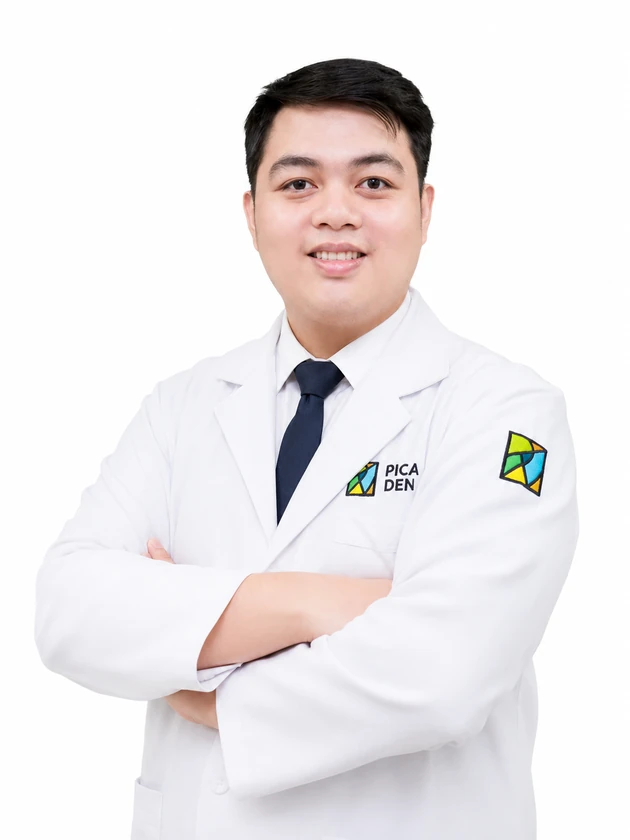
Medically reviewed by
Dr. Hung Le Ba Gia
Lead Implant Specialist, Picasso Dental Clinic
DDS · 1,000+ implants placed · 200+ All-on-4 cases · Picasso Dental Clinic implant team
Clinical focus: Implantology · Single implants · All-on-4 · Multi-unit implant bridges
Dr. Hung Le Ba Gia (also known as Dr. Evans) is Lead Implant Specialist at Picasso Dental Clinic, with over 1,000 implants placed and more than 200 full-arch All-on-4 cases completed. His caseload covers single-tooth replacement, multi-unit implant bridges, and full-arch rehabilitation across the Osstem, ETK, Neodent, Nobel Biocare, and Straumann systems.
Useful answers
Frequently asked questions
Who pioneered the All-on-4 protocol at Picasso?
Dr. Hung Le Ba Gia, our Lead Implant Specialist, leads All-on-4 cases at Picasso. He has completed 200+ All-on-4 cases across all fixture tiers.
What is the All-on-4 survival rate at Picasso?
Across our 1,000+ case archive, cumulative All-on-4 fixture survival sits within the 94-98% range reported by Maló (the protocol originator) and other peer-reviewed long-term studies. We do not publish a single Picasso-specific number above this band without the statistical workup the literature requires.
Are prosthetic complications common?
Yes — and more common than fixture failures. Across the published literature, prosthetic complications (screw loosening, temporary fracture, crown chipping) affect 20-40% of All-on-4 cases over 10 years. Most are repairable. Our experience matches this range.
Does Osstem perform worse than Nobel Biocare for All-on-4?
Not when matched for case complexity and bone profile. The published literature does not show a clinically significant survival difference between major implant brands in All-on-4 cases. The tier choice at Picasso (Osstem, ETK/Neodent, Nobel Biocare/Straumann) is about manufacturer warranty, parts availability, and surface chemistry research base — not crude survival.
What happens if a fixture fails?
All-on-4 is designed with redundancy — if one fixture fails, the remaining three can usually support a modified bridge while the failed site heals and a replacement is placed. Failures within the first year are covered by our warranty.