Questions
Can I fly after dental implants?
Most patients can fly 3–5 days after a single implant at Picasso Dental Clinic. Full-arch All-on-4 cases typically require 5–7 days before long-haul travel. Clearance is confirmed in writing at your post-op appointment — May 2026.
At Picasso Dental Clinic, most NZ patients receive written flight clearance 3–5 days after uncomplicated single implant placement, or 5–7 days after full-arch surgery such as All-on-4; sinus augmentation cases require 7–10 days minimum; clearance is confirmed at a dedicated post-op appointment before departure — May 2026.
Flying home after dental implant surgery is a common concern for NZ patients who combine treatment with a trip to Vietnam. The honest answer is that timing matters, but most patients fly home without incident when the minimum healing window is respected. This page explains how we set that window and what to do if anything changes on the way home.
The short answer
Most patients can fly 3–5 days after uncomplicated single implant placement. Full-arch cases such as All-on-4 typically require 5–7 days before a long-haul flight. Your specific clearance is given in writing at your post-op appointment — we do not estimate this in advance because healing varies by patient, grafting complexity, and surgical site.
If in doubt, stay one extra day.
Why flying too soon carries risk
Cabin pressure changes at cruising altitude do not directly affect an implant fixture or bone graft material. The implant is titanium; the graft is stable particulate. Pressure is not the clinical concern.
The risks are indirect:
Post-surgical bleeding. Minor oozing in the first 12–24 hours is normal after implant placement. If a bleed becomes more than minor, managing it on a 10-hour flight is difficult. Being close to the clinic for the first two to three days means any issue can be addressed promptly.
Infection signs may not appear until day 3–4. An early post-surgical infection may be silent on day two but visible by day four. Departing before the window closes means you could be mid-Pacific when signs become apparent.
Treatment continuity. If a complication arises mid-flight or shortly after landing in New Zealand, you are presenting to a new dentist who has not seen your imaging. That dentist can treat you — but continuity of care is easier when the original clinical team has had at least one post-op look.
Dehydration and dry mouth. Recycled cabin air is drier than ground air. Adequate moisture at the surgical site supports mucosal healing. Long-haul dehydration slows this process and increases discomfort.
What affects your fly-home date
| Factor | Typical minimum before flying |
|---|---|
| Single implant, no graft | Day 3–5 (if healing is normal) |
| Single implant + bone graft | Day 5–7 |
| All-on-4 (single arch) | Day 5–7 |
| All-on-4 (two arches) | Day 5–7 minimum |
| Sinus augmentation (one side) | Day 7–10 |
| Sinus augmentation (bilateral) | Advised individually by Dr. Hung Le Ba Gia |
| Complex full-mouth reconstruction | Advised individually |
These figures assume normal healing at the time of your post-op review. If healing is slower — for example, if swelling has not reduced to expected levels, or if there is any discharge from the site — your clearance date will be extended. Your post-op appointment exists specifically to make this assessment.
How we build the fly-home date into your trip plan
When you book treatment, Picasso provides a written treatment timeline that includes the surgery date, post-op appointment date, and earliest expected departure date. This timeline is built around your procedure type.
We recommend booking refundable return flights until you have a confirmed surgery date and a realistic idea of your case complexity. Once your pre-treatment assessment is complete and the clinical team has reviewed your CBCT imaging, the timeline becomes more predictable.
Your final appointment before departure includes:
- A clinical review of the surgical site
- Assessment of swelling, bleeding, and suture status
- Confirmation (or adjustment) of your written clearance note
- A discharge pack with post-op instructions in English, your implant passport, and emergency contact details
What to do on the flight home
Practical steps for the journey:
- Keep your head slightly elevated in the seat — do not recline flat with your face down.
- Avoid alcohol for the entire flight; it causes vasodilation and can increase post-surgical bleeding and swelling.
- Take prescribed antibiotics at the correct interval, adjusting for the time-zone change from Vietnam to New Zealand.
- Stay hydrated — water, not soft drinks.
- If there is residual facial swelling, a cold compress (wrapped in a cloth, not applied directly) for 10–15 minutes can help.
- Carry your Picasso post-op instructions, implant passport, and the [email protected] contact in your hand luggage. If you feel unwell mid-flight, cabin crew can note it and you can show a receiving dentist the documentation immediately on landing.
Do not take aspirin or ibuprofen for pain unless specifically prescribed — both increase bleeding tendency. Use paracetamol if pain relief is needed.
If you have symptoms after landing
Email Picasso at [email protected] with photos as your first step. Include: the date of surgery, what you are experiencing, and a clear photograph of the site if visible.
We can assess remotely and advise whether:
- The symptom is a normal variation and no treatment is needed
- You should see a NZ dentist for assessment
- Antibiotic cover needs to be extended
We will also prepare any documentation your NZ dentist requires — including imaging, implant specifications, and the treatment summary — so your local provider can continue care without starting from scratch.
For NZ-based follow-up guidance, see Implant aftercare for NZ patients returning home.
Next step
If you are planning implant treatment and want to understand the full trip timeline before booking, see Dental implants in Vietnam for NZ patients or All-on-4 at Picasso. For a personalised timeline based on your specific case, request a free written quote or email [email protected]. For aftercare and warranty information see /aftercare/ and /warranty/. Safety overview at /is-it-safe/.
About this page
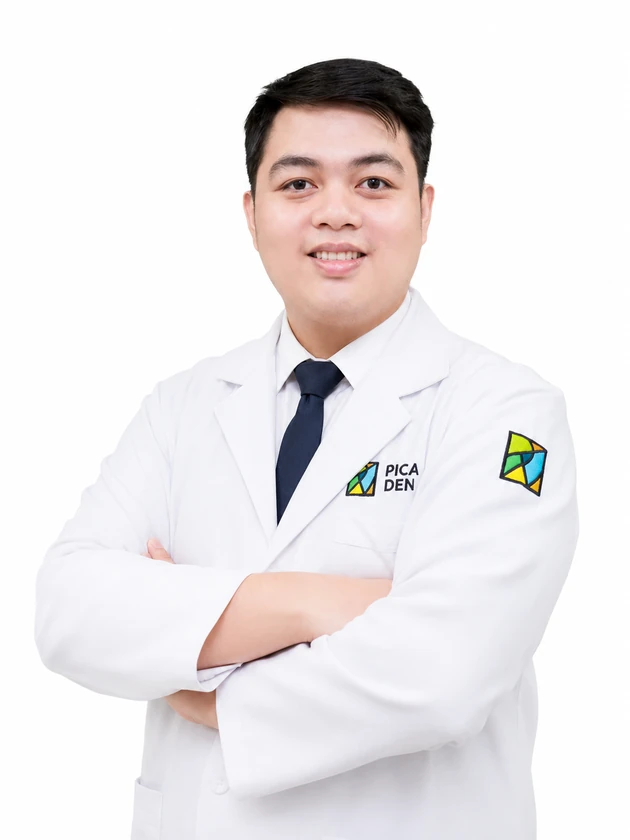
Medically reviewed by
Dr. Hung Le Ba Gia
Lead Implant Specialist, Picasso Dental Clinic
DDS · 1,000+ implants placed · 200+ All-on-4 cases · Picasso Dental Clinic implant team
Clinical focus: Implantology · Single implants · All-on-4 · Multi-unit implant bridges
Dr. Hung Le Ba Gia (also known as Dr. Evans) is Lead Implant Specialist at Picasso Dental Clinic, with over 1,000 implants placed and more than 200 full-arch All-on-4 cases completed. His caseload covers single-tooth replacement, multi-unit implant bridges, and full-arch rehabilitation across the Osstem, ETK, Neodent, Nobel Biocare, and Straumann systems.
Useful answers
Frequently asked questions
How many days after a single dental implant can I fly back to New Zealand?
Most patients with an uncomplicated single implant placement can fly 3–5 days after surgery. Your Picasso post-op appointment confirms clearance in writing before you book your departure. If a bone graft was placed at the same time, the minimum increases to 5–7 days.
How long should I stay in Vietnam after All-on-4 surgery before flying?
All-on-4 treatment involving two arches carries a minimum 5–7 day pre-flight window. Dr. Hung Le Ba Gia reviews each full-arch case individually at the post-op appointment and may extend this if healing is slower than expected. We recommend booking refundable return flights.
Does cabin pressure affect dental implants or bone grafts?
Cabin pressure changes do not directly affect the implant fixture or graft material. The risks of flying too soon are indirect: difficulty managing any post-surgical bleeding, infection signs that may not become apparent until days 3–4, and dehydration on long-haul flights that slows mucosal healing.
What happens if I have a complication mid-flight or after landing in NZ?
Email Picasso at [email protected] with photos and a description as soon as you can. We can advise remotely and prepare documentation for your NZ dentist. Carry your Picasso post-op instructions and implant passport on the plane — any dentist or emergency dental service can use them to continue your care.
Does sinus augmentation change my fly-home date?
Yes. Sinus augmentation is a more extensive procedure with higher pressure sensitivity in the early healing days. The recommended minimum before flying is 7–10 days. Some patients with bilateral sinus lifts may be advised to stay longer — Dr. Hung Le Ba Gia confirms this individually.
What should I do on the flight home after implant surgery?
Keep your head slightly elevated, avoid alcohol, use a cold compress on your face if there is residual swelling, take your prescribed antibiotics at the correct interval regardless of time-zone changes, stay well hydrated, and carry your post-op instructions and implant records in your hand luggage.
Does Picasso provide written flight clearance before I leave?
Yes. Your final appointment at Picasso includes a post-op review and an explicit written clearance note. This forms part of your treatment documentation and can be shown to any medical provider if questions arise on the flight or after landing.