All on 4
All-on-4 dental implants in Vietnam for New Zealand patients
All-on-4 at Picasso Dental Clinic from NZD 8,333 per arch (Osstem) to NZD 14,667 (Nobel/Straumann), CBCT-guided protocol, Dr. Hung Le Ba Gia, May 2026.
At Picasso Dental Clinic in Vietnam, All-on-4 dental implants cost NZD 8,333 per arch (Osstem), NZD 10,000 (ETK/Neodent), or NZD 14,667 (Nobel Biocare/Straumann) as of May 2026 (1 NZD = 15,000 VND), compared with a New Zealand anonymous private-clinic benchmark of NZD 25,000 to NZD 45,000+ per arch, using a CBCT-guided protocol with immediate loading in eligible cases, a written manufacturer and prosthetic warranty, and surgery led by Dr. Hung Le Ba Gia who has placed 15,000+ implants and treated 1,000+ All-on-4 patients since 2010.
Most people who contact us about All-on-4 are comparing a NZ private fee they’ve been quoted against our Vietnam price and wondering whether the saving justifies a two-trip commitment. The honest answer depends on how much bone you have, which implant system you choose, and whether you can manage healing in New Zealand between two visits.
This page sets out the clinical picture, our NZD prices with a dated NZ benchmark beside them, and the cases where flying to Vietnam for All-on-4 does not make sense. Read it before requesting a quote.
What All-on-4 actually is
All-on-4 is a full-arch implant-supported fixed bridge. Four titanium implants are placed into the jaw bone — two upright at the front and two angled posteriorly to maximise contact with available bone — and a complete arch of teeth is attached to those four fixtures.
It is not a denture. A denture rests on the gum and is removable. All-on-4 is fixed in the mouth and can only be removed by a dentist.
It is also different from placing one implant per missing tooth. Traditional multi-implant full-arch rehabilitation can involve six, eight, or ten implants per arch. All-on-4 reduces that to four precisely placed fixtures, which lowers the surgical load and eliminates the need for extensive grafting in many — not all — cases where bone has already resorbed.
The clinical trade-off: four implants share the prosthetic load across a full arch. Long-term stability depends on implant position, bone quality, bite forces, and the patient’s maintenance compliance. All of these are assessed before surgery, not assumed.
Our All-on-4 prices in NZD — May 2026
Prices below are from the May 2026 Picasso price list, converted at 1 NZD = 15,000 VND.
| Implant system | Price per arch | Prosthetic warranty | Best for |
|---|---|---|---|
| Osstem | NZD 8,333 | Written warranty, terms in treatment plan | Strong cost saving, globally distributed Korean system |
| ETK / Neodent | NZD 10,000 | Written warranty, terms in treatment plan | European/global mid-tier, Straumann-group distributed |
| Nobel Biocare / Straumann | NZD 14,667 | Written warranty, terms in treatment plan | Long-term NZ serviceability, globally distributed parts |
What the arch price includes:
- Four implant fixtures (the named system above)
- Abutments
- Full-arch prosthesis (provisional or final, specified in your treatment plan)
What the arch price excludes:
- Extractions of remaining failing teeth (quoted separately)
- Bone grafting or sinus augmentation if required (quoted separately after CBCT)
- IV sedation (available on request, quoted separately)
- Pre-surgical diagnostics where not already held
Ask us to show the complete line-item quote, not only the per-arch headline. See the full itemised pricing list.
For the full New Zealand-vs-Vietnam breakdown with city-by-city benchmarks, see our All-on-4 cost guide.
New Zealand vs Vietnam — the honest economics
| Scenario | NZ anonymous benchmark | Picasso Vietnam | Indicative saving |
|---|---|---|---|
| Single arch — Nobel Biocare / Straumann | NZD 25,000 to NZD 45,000+ | NZD 14,667 | NZD 10,333 to NZD 30,333+ |
| Both arches — Nobel Biocare / Straumann | NZD 50,000 to NZD 90,000+ | NZD 29,334 | NZD 20,666 to NZD 60,666+ |
| Single arch — Osstem | NZD 25,000 to NZD 45,000+ | NZD 8,333 | NZD 16,667 to NZD 36,667+ |
| Both arches — Osstem | NZD 50,000 to NZD 90,000+ | NZD 16,666 | NZD 33,334 to NZD 73,334+ |
NZ benchmarks are anonymous planning figures based on indicative private-clinic fees, not a quote from any specific clinic or chain. Your own dentist’s written quote is the correct local comparison.
Break-even logic. Return flights from Auckland to Hanoi run approximately NZD 1,400 to NZD 2,200 depending on airline and season. Ten to fourteen nights of mid-range accommodation adds roughly NZD 1,200 to NZD 2,400. Add living costs and the cost of annual leave. At these total travel costs, even a single-arch Nobel Biocare case produces an indicative net saving of NZD 8,000 or more over the NZ benchmark. Both arches produce a saving in the tens of thousands even at the most conservative estimate.
The numbers do not make this an obvious decision. The right framing is: does the saving justify two trips, healing at home between them, and the work of managing aftercare remotely? For most full-arch patients, the answer is yes. For some, it is not — see the sections below on candidacy and when to stay in New Zealand.
Who is a good candidate for All-on-4?
All-on-4 suits patients who meet the following criteria:
- Most or all teeth in at least one arch are missing or clinically failing and cannot be predictably saved
- Adequate jaw bone volume is present in the four implant positions, or manageable bone deficiencies that do not require major grafting
- The patient is medically stable — no uncontrolled diabetes, no active malignancy, no bisphosphonate or anti-resorptive therapy that would significantly impair healing
- Non-smoker or a smoker who can genuinely stop for the full 3 to 6 month osseointegration period
- Able to commit to two trips and to maintaining hygiene under a fixed bridge long-term
Not every patient who inquires about All-on-4 is a candidate. If the CBCT shows insufficient bone in the posterior positions, or if medical history creates surgical risk we cannot safely manage remotely, we say so in writing and suggest alternatives — including staying in New Zealand for treatment.
If you have advanced bone loss on the upper arch, ask us specifically about zygomatic implants. These anchor into the cheekbone (zygoma) rather than the jaw and are designed for patients where standard All-on-4 is not viable.
The CBCT-guided All-on-4 protocol
Our All-on-4 placement follows a seven-step CBCT-guided protocol.
| Step | What happens | Why it matters |
|---|---|---|
| 1. Diagnostics | OPG and CBCT 3D scan on arrival; full clinical examination; photographs | Establishes bone volume, nerve position, sinus height, and implant axis before any surgery |
| 2. Treatment planning | Implant positions modelled against final prosthetic tooth positions | Prevents the common error of placing implants in positions that do not support the planned bridge |
| 3. Surgical guide fabrication | A CBCT-derived surgical guide is made to direct drill angles precisely | Reduces deviation from the planned implant axis and improves accuracy |
| 4. Extraction and site preparation | Failing teeth removed; sockets prepared or healed as the plan requires | Extractions and placement can sometimes occur in the same session where bone quality allows |
| 5. Implant placement | Four fixtures placed under local anaesthesia; primary stability measured | Primary stability (torque values) determines whether immediate loading is feasible |
| 6. Immediate loading (where eligible) | A provisional full-arch bridge is fitted the same day in cases with sufficient primary stability | Patients leave with fixed provisional teeth rather than going home edentulous |
| 7. Healing and final prosthesis | 3 to 6 months osseointegration in New Zealand; Trip 2 for final bridge scan, fabrication, and fitting | The final prosthesis is made to precise measurements after full integration |
Immediate loading is not guaranteed. It is clinically confirmed on the day of surgery based on torque readings. If primary stability is insufficient, a healing period without loading is the safer path — and we say so.
Implant system choice — does the brand matter?
Yes, for a specific reason that matters to New Zealand patients: parts availability.
| System | Origin | Global distribution | NZ serviceability | Our NZD price per arch |
|---|---|---|---|---|
| Osstem | South Korea | Distributed in 80+ countries | Parts available through NZ channels | NZD 8,333 |
| Neodent | Brazil (Straumann Group) | Distributed in 100+ countries | Parts available through NZ channels | NZD 10,000 |
| ETK | Europe | Distributed in Europe and Asia-Pacific | Enquire with NZ dental suppliers | NZD 10,000 |
| Nobel Biocare | Sweden / USA | Distributed in 90+ countries including NZ | Readily available through NZ distributor | NZD 14,667 |
| Straumann | Switzerland | Distributed in 100+ countries including NZ | Readily available through NZ distributor | NZD 14,667 |
Our recommendation for NZ patients who prioritise long-term local maintenance: Nobel Biocare or Straumann. Both systems have established New Zealand distributor networks. Your local dentist can order replacement screws, healing abutments, and prosthetic components without long lead times.
If the primary goal is the lowest per-arch cost and you are comfortable with the slightly more limited local-parts picture, Osstem delivers strong clinical outcomes at meaningful savings.
Whatever system you choose, your discharge pack includes an implant passport with brand name, fixture dimensions, system code, and torque values — enough for any competent New Zealand dentist to look up the specifications and order parts.
How many extractions are needed before All-on-4?
If you still have remaining teeth in the arch, they must be assessed individually. Teeth that are salvageable are not automatically removed. Teeth that are clinically failing — mobile, heavily infected, fractured below the gum line, or compromising implant position — are extracted before or during the implant placement session.
In many cases, extractions and implant placement can occur in the same surgical visit. This is confirmed on the day after examining the CBCT and the clinical picture. Where a tooth socket requires healing before implant placement (particularly after significant infection), a staged approach is planned and the timing adjusted.
Your NZD quote will state explicitly whether extractions are included in the arch price or quoted separately. This is one of the most common sources of quote-comparison confusion — always ask.
The typical Kiwi All-on-4 trip timeline
| Phase | Activity | Duration |
|---|---|---|
| Before travel | Send photos, OPG/CBCT if available, medical history, NZ quote — receive written NZD plan | 1 to 3 days (remote) |
| Trip 1 — Days 1–2 | CBCT scan, clinical consultation, extractions if needed, surgical planning | 2 days |
| Trip 1 — Days 3–4 | Implant placement; immediate loading of provisional bridge where eligible | 1 day surgery + 1 day rest |
| Trip 1 — Days 5–7 | Post-operative review, swelling assessment, healing instructions, emergency contact details | 2 to 3 days |
| Return home | Provisional fixed bridge in place; soft diet; healing period begins | — |
| Healing period | Osseointegration at home in New Zealand; routine NZ dentist review recommended | 3 to 6 months |
| Trip 2 — Days 1–2 | Digital scan of integrated implants, framework or bridge design confirmed | 2 days |
| Trip 2 — Days 3–5 | Final prosthesis fabricated, fitted, bite adjusted, reviewed | 2 to 3 days |
| Total per trip | Trip 1: 7 to 10 days minimum; Trip 2: 5 to 7 days minimum | Two separate trips |
Do not book a flight home immediately after the surgical day. Build in rest time. The provisional bridge is functional but the surgical sites need days to settle before long-haul travel is comfortable.
When All-on-4 is the wrong answer
We will say this directly in your written plan if it applies to your case:
- Insufficient bone without grafting. All-on-4 in standard configuration requires adequate bone in all four fixture positions. If you need substantial bone grafting or a sinus lift before implants can be placed, the plan may require staging across two trips to Vietnam — the first for grafting, then a second treatment course months later. This changes the economics and the commitment.
- Active uncontrolled gum disease. Periodontal disease must be treated and stable before implant placement. We will not place implants into an infected mouth.
- Medical conditions requiring local management. Uncontrolled diabetes, active bisphosphonate therapy, recent jaw radiotherapy, and certain immunosuppressive conditions carry elevated implant failure risk. Some of these are best managed by a specialist in New Zealand rather than by us remotely.
- Cannot commit to the second trip. The final prosthesis requires a second visit. If life circumstances mean you cannot return in 3 to 9 months for the final bridge, All-on-4 in Vietnam may leave you in a prolonged provisional phase.
- Refuses a second trip on principle. A single-trip All-on-4 with same-day final bridge is possible in a minority of cases with ideal bone and bite, but it is not the standard path and is not appropriate for most patients.
Read is dental tourism safe? and honest risks before committing to any overseas surgical procedure.
Stay in New Zealand if…
- You need fewer than six teeth replaced — single implants or an implant bridge is a more conservative choice
- You have uncontrolled Type 2 diabetes or blood sugar management is uncertain
- You are currently on bisphosphonate or anti-resorptive medication for osteoporosis or cancer treatment
- You have had radiotherapy to the jaw or neck within the past five years
- You smoke heavily and are not able to stop for the 3 to 6 month healing period
- You cannot take 7 to 10 days off for Trip 1 and a further 5 to 7 days for Trip 2
- Your case requires ACC funding available only through NZ-registered providers
- You have an active dental infection that requires urgent local treatment before any planned implant work
This is not a barrier list designed to deter you. It is a practical guide to whether the overseas pathway suits your clinical situation. Patients who travel without addressing these flags have worse outcomes regardless of where surgery is performed.
Our All-on-4 team
Dr. Hung Le Ba Gia (Dr. Evans) — Lead Implant Specialist
Dr. Evans is our Lead Implant Specialist with 1,000+ implants and 200+ All-on-4 cases in his clinical record. He leads the implant programme for international patients.
Dr. Hung reviews every All-on-4 CBCT and treatment plan before surgery is scheduled. He is the treating clinician for All-on-4 cases at our clinic.
What your written All-on-4 quote includes
Every written NZD quote we provide before you book flights includes:
- Arch specification: upper only, lower only, or both arches
- Implant brand and system named per fixture (Osstem, ETK, Neodent, Nobel Biocare, or Straumann)
- Number of implants per arch and their positions (standard four-implant configuration, or a variation)
- Prosthesis type: provisional full-arch bridge or final bridge, with material named (acrylic, titanium-reinforced acrylic, zirconia)
- Whether extractions are included in the arch price or quoted separately
- Whether bone grafting, sinus augmentation, or zygomatic implants are needed and priced separately
- Whether IV sedation is included or an optional extra
- Diagnostic scan costs (OPG, CBCT) if not already provided
- Warranty terms: implant manufacturer warranty and prosthetic warranty, both in writing
- Number of trips and estimated duration for each
- All prices in NZD, dated, with exchange rate stated (1 NZD = 15,000 VND, May 2026)
- A clear statement if we recommend against All-on-4 and what alternative we suggest
If the CBCT on day one of your first trip changes the clinical picture — for example, a sinus lift is needed on one side that was not evident from the OPG — the revised plan is given to you in writing before any surgery proceeds. No on-arrival price surprises.
8 questions to ask before paying any deposit
Ask these of any clinic — including us — before paying anything:
- Does the quoted arch price include the temporary (provisional) bridge, or is that an extra?
- What is the final bridge material, and is it included in the quoted price or quoted separately?
- Are extractions included, or are they billed separately on arrival?
- What implant brand and system will be used, and what is the fixture length and diameter?
- What happens if primary stability is insufficient on the day and immediate loading is not possible?
- What bone grafting or sinus work might be needed, and how is this identified and priced?
- What documents will I take home — implant passport, prosthetic specs, torque values, warranty certificate?
- How many trips does the plan assume, and what does Trip 2 cost if not included?
A clinic that cannot or will not answer all eight questions clearly in writing before you pay a deposit is a clinic worth approaching with caution.
What to send for an accurate quote
Send us the following for a written NZD plan:
- Full-mouth photos: natural smile, lips retracted showing all teeth, upper arch, lower arch, left bite, right bite
- OPG (panoramic X-ray) if your NZ dentist has taken one in the past 12 months
- CBCT 3D scan if available — this produces the most accurate implant position assessment
- Photos of any current denture or partial denture
- Your medical history, including current medications, diabetes status, smoking history, and any bone medication
- Any existing NZ full-arch implant quote, if you have one — this helps us identify scope differences
Send to [email protected]. We return a written NZD plan within 24 hours on weekdays NZ time. The plan is provisional until clinical examination in Vietnam, but it will be detailed enough for you to compare line by line against your NZ quote.
Aftercare when you return to New Zealand
After your provisional bridge is placed at the end of Trip 1:
- Diet: Soft foods for the first 6 to 8 weeks. No hard crusts, raw carrots, or anything that applies direct impact load to the bridge. We provide written dietary guidance.
- Hygiene: Water flossers and interdental brushes under the bridge are essential. Standard floss alone is not sufficient. We demonstrate technique before discharge.
- Hygiene appointments: Book a professional clean with your NZ dentist or hygienist at the 3-month mark. The bridge requires professional debridement underneath.
- Bite changes: If the bridge feels high, tight, or rubs the cheek within days of returning home, contact us and your local dentist promptly — do not wait for Trip 2.
- Documentation: You leave with an implant passport (brand, dimensions, system code, torque values), written healing instructions, warranty documentation, and our contact email for remote follow-up questions.
- NZ dentist check: We recommend showing your NZ dentist the implant passport and healing instructions at the 6-week or 3-month mark so they are oriented to your case before Trip 2.
After Trip 2 and final bridge placement, ongoing care follows a standard implant maintenance schedule: professional hygiene every 6 months, annual bite review, and a night guard if there is any evidence of grinding. See implant aftercare and warranty terms for the full written programme.
Next step
Send us your records and we will return a written NZD All-on-4 plan within 24 hours on weekdays. The plan will name the implant system, arch count, prosthesis type, extraction and grafting status, number of trips, warranty terms, and every price in NZD — dated May 2026 at 1 NZD = 15,000 VND.
Free NZD quote · Full pricing · Is it safe? · Implant brands
About this page
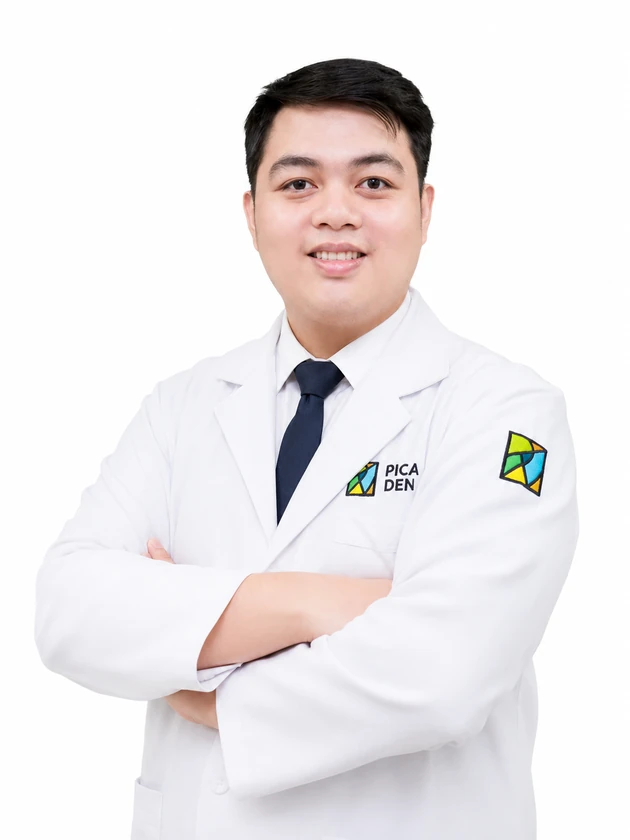
Medically reviewed by
Dr. Hung Le Ba Gia
Lead Implant Specialist, Picasso Dental Clinic
DDS · 1,000+ implants placed · 200+ All-on-4 cases · Picasso Dental Clinic implant team
Clinical focus: Implantology · Single implants · All-on-4 · Multi-unit implant bridges
Dr. Hung Le Ba Gia (also known as Dr. Evans) is Lead Implant Specialist at Picasso Dental Clinic, with over 1,000 implants placed and more than 200 full-arch All-on-4 cases completed. His caseload covers single-tooth replacement, multi-unit implant bridges, and full-arch rehabilitation across the Osstem, ETK, Neodent, Nobel Biocare, and Straumann systems.
Useful answers
Frequently asked questions
How much does All-on-4 cost at Picasso Dental Clinic in NZD?
As of May 2026, All-on-4 at Picasso Dental Clinic costs NZD 8,333 per arch for Osstem implants, NZD 10,000 per arch for ETK or Neodent, and NZD 14,667 per arch for Nobel Biocare or Straumann. Prices use 1 NZD = 15,000 VND. A full upper and lower (both arches) Nobel Biocare or Straumann case is NZD 29,334. The arch price includes four implant fixtures, abutments, and the full-arch prosthesis. It excludes extractions, bone grafting, sinus lifts, sedation, and any additional diagnostic scans not already quoted.
How much does All-on-4 cost in New Zealand?
The anonymous private-clinic benchmark for All-on-4 in New Zealand is NZD 25,000 to NZD 45,000+ per arch as of May 2026. These are planning figures based on indicative private fees, not a quote from any specific clinic. Your own dentist's written quote is the correct local comparison. The gap between the NZ benchmark and our Vietnam prices is large enough that even one arch — with flights and accommodation factored in — is typically financially compelling.
What warranty does Picasso offer on All-on-4?
The implant fixtures carry the manufacturer's warranty from the implant system chosen — Osstem, ETK, Neodent, Nobel Biocare, or Straumann. The prosthetic bridge is covered under our written prosthetic warranty, typically 5 to 10 years depending on the bridge material specified in your treatment plan. We do not claim a lifetime warranty on any component. All warranty terms are provided in writing before surgery.
Who performs All-on-4 surgery at Picasso?
Dr. Hung Le Ba Gia (Dr. Evans), our Lead Implant Specialist, leads All-on-4 cases. He has placed over 1,000 dental implants and completed more than 200 full-arch All-on-4 restorations at Picasso Dental Clinic.
How many trips to Vietnam does All-on-4 require?
Most All-on-4 patients need two trips. Trip 1 covers CBCT diagnostics, extractions where needed, implant placement, and a provisional full-arch bridge in eligible immediate-loading cases — typically 7 to 10 days. After 3 to 6 months of healing in New Zealand, Trip 2 covers the final prosthesis fitting and review — typically 5 to 7 days. Some cases with excellent primary stability may consolidate into one extended trip; this is confirmed only after CBCT and bone assessment, never assumed in advance.
What implant brand should I choose for All-on-4?
Nobel Biocare or Straumann is the most practical choice for New Zealand patients who want long-term NZ dentist serviceability, because replacement components, drivers, and torque specifications for both systems are available through New Zealand distributor channels. Osstem and Neodent are globally recognised systems with strong clinical track records and meaningful cost savings per arch. We will state the specific brand, fixture diameter, length, and system code on your implant passport so your NZ dentist can order parts.
What if I do not have enough bone for All-on-4?
A CBCT scan on day one establishes bone volume before any surgery is performed. If standard All-on-4 is not feasible, options include bone grafting, sinus lift augmentation, tilted-implant designs, or in the most atrophic upper jaws, zygomatic implants. Any deviation from the original plan is provided in writing before you proceed.
Is All-on-4 reversible?
No. All-on-4 involves surgical placement of four titanium implants into the jaw bone and is not reversible. The prosthetic bridge on top can be removed and replaced; the implants themselves integrate with the jaw permanently. This is why we require CBCT imaging and a written treatment plan before any surgery is scheduled.
Can my New Zealand dentist maintain my All-on-4 bridge?
Yes. We provide an implant passport on discharge that includes the brand, fixture diameter, length, system code, and torque values for every implant placed. We also supply prosthetic specifications and written warranty documents. Most New Zealand general dentists can perform routine hygiene, bridge checks, and basic maintenance using this documentation. Nobel Biocare, Straumann, and Neodent components are available through New Zealand distributor networks.
What should I send for an accurate All-on-4 quote?
Send full-mouth photos (smile, retracted upper and lower arches, left and right bite views), an OPG or CBCT if you have one, a photo of any current denture, your medical history including diabetes, blood thinners, bisphosphonates and smoking status, and any existing NZ full-arch quote. Email [email protected]. We return a written NZD plan within 24 hours on weekdays NZ time.